The magic of the silver screen has always been built on a foundation of technical trickery, from the hand-painted glass shots of the early 20th century to the groundbreaking CGI of the 1990s. But as we move through 2026, we are witnessing a shift that many industry veterans describe as the most significant since the transition from silent film to “talkies.” Artificial Intelligence is no longer just a buzzword in Silicon Valley; it has become the silent, powerful engine behind the modern visual effects (VFX) pipeline.
Unlike the traditional “CGI era,” where every pixel was painstakingly placed by an artist over months of labor, the AI-driven era of filmmaking is characterized by speed, collaboration, and a democratization of high-end tools. This transformation isn’t about replacing the artist; it is about removing the “friction” of the process, the thousands of hours of repetitive, manual labor that often stood between a director’s vision and the final frame.
The Evolution of the “VFX Generalist”
For years, the VFX industry was built on extreme specialization. One artist might spend their entire career focused solely on the physics of water, while another specialized in “rotoscoping”, the frame-by-frame tracing of actors to separate them from their backgrounds. In 2026, AI is effectively collapsing these silos.
Tools like Foundry Nuke’s CopyCat and Adobe Sensei have revolutionized the “grunt work” of post-production. Tasks that once required an army of junior artists, such as removing a microphone from a shot or cleaning up a stray reflection in a window, are now handled by machine learning algorithms in a fraction of the time. This has led to the resurgence of the “VFX Generalist” a single creator who, empowered by AI, can handle the entire pipeline from lighting to compositing.
This shift is having a profound impact on production budgets. Industry reports suggest that AI efficiencies can shave up to 30% off the total programming expenses for major studios. For independent filmmakers, this means that a “Hollywood-level” look is no longer locked behind a $200 million price tag.
Virtual Production and Real-Time Decisions
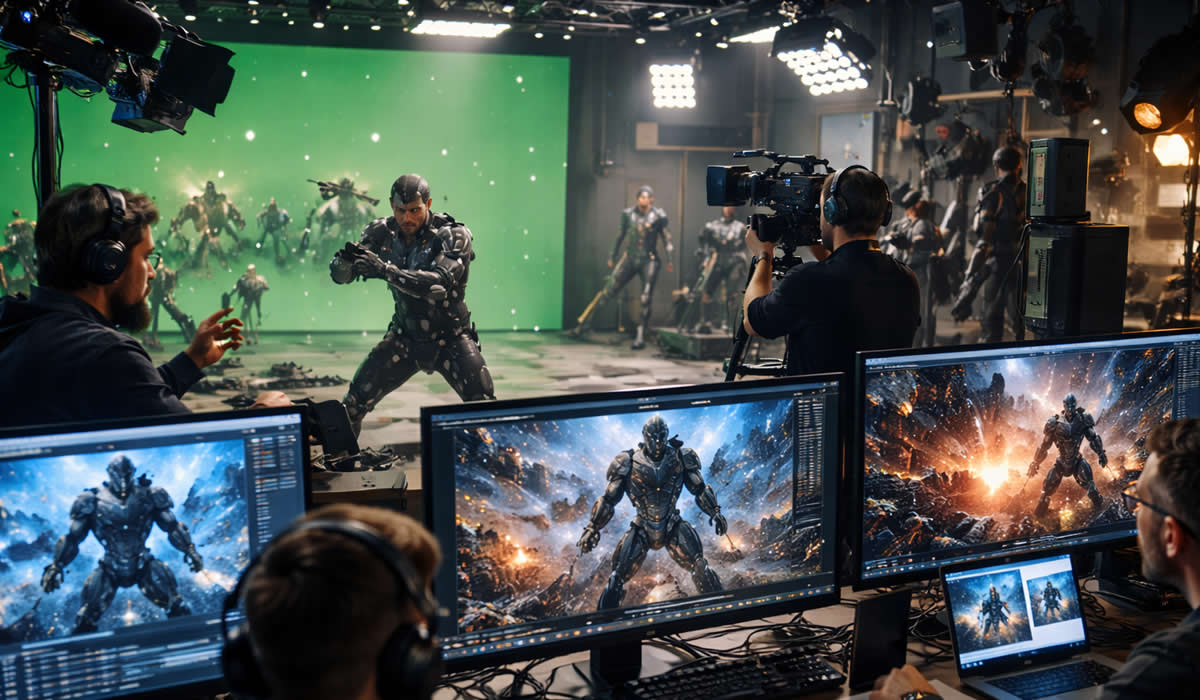
Perhaps the most visible change in 2026 is the expansion of Virtual Production. By combining LED volumes massive walls of high-resolution screens, with real-time engines like Unreal Engine 5.4, directors can see the finished visual effects while they are still on set.
AI plays a critical role here by managing “in-camera VFX.” These systems use neural renderers to instantly adjust the lighting of the digital environment to match the physical lights on the actors. If a director decides to move a digital mountain ten feet to the left, the AI recalculates the shadows and reflections on the actor’s skin in real-time. This eliminates the “green screen blues,” where actors had to perform against a blank wall and hope for the best. Now, they can see the alien planet or the historical city they are supposed to be inhabiting, leading to more grounded, authentic performances.
The Digital Performer: De-Aging and Beyond
One of the most debated uses of AI in cinema is the creation of digital humans. We have moved past the “uncanny valley” of early digital faces into a territory where de-aging and posthumous performances are nearly indistinguishable from reality.
Metaphysic and Respeecher are at the forefront of this trend. Using deep-learning models, these tools can analyze thousands of hours of an actor’s past work to recreate their younger self with perfect muscle movement and skin texture. In 2026, this technology is being used not just for stunts, but for “digital makeup.” An actor can be aged fifty years in a single shot without a minute of physical prosthetics, allowing for more fluid movement and subtler emotional expressions that traditional makeup would otherwise stifle.
| AI Application | Primary Function | Estimated Time/Cost Saving |
| Generative Pre-viz | Creating rough clips from script prompts | 70% reduction in storyboarding |
| Neural Rendering | Real-time lighting and physics calculations | 50% faster render times |
| Automated Roto | Tracing actors and objects frame-by-frame | 80% reduction in manual labor |
| Voice Synthesis | Ethical voice cloning for dubbing/de-aging | 90% reduction in ADR sessions |
The Preservation of the “Handmade”
Despite the technological leaps, 2026 has also seen a surprising resurgence in the appreciation for human craftsmanship. As AI-generated content becomes more ubiquitous, there is a growing market for what some call the “Handmade Premium.”
Prominent filmmakers like Ben Affleck have noted that while AI is excellent at “regressing to the mean” producing a technically perfect average of its training data, it lacks the lived experience required to create something truly original and moving. The “complications of real life,” such as a slight crack in a voice or a deliberate imperfection in a shot, are what audiences connect with emotionally.
The industry is currently finding a balance: using AI to handle the “burdensome” tasks, the crowd scenes, the background cleanup, and the rendering while leaving the creative “soul” of the film to human directors, writers, and actors. This human-AI collaboration model is the true 2026 standard.
Looking Ahead: The 2026 Tech Stack
For those interested in the technical “under-the-hood” aspects of modern VFX, the following tools are currently defining the state of the art:
- NVIDIA Omniverse: A platform for real-time collaboration where artists using different software (like Maya, Blender, and Unreal) can work on the same scene simultaneously.
- OpenAI Sora & Runway Gen-3: These generative video models are becoming standard for “pre-visualization,” allowing directors to generate entire mood boards and concept reels from a simple text prompt.
- Autodesk Flow: A unified cloud platform that integrates AI throughout the entire production cycle, from script analysis to final color grading.
A Tool, Not a Replacement
As the lights go down in theaters across the world in 2026, the images on screen are more spectacular than ever. But behind those images isn’t just a machine; it is a new generation of artists who have learned to speak the language of AI.
The revolution in visual effects hasn’t replaced the magic of cinema; it has simply expanded the wizard’s toolkit. By automating the tedious and making the impossible affordable, AI is allowing a wider range of voices to tell their stories. In the end, the technology is like electricity: it is essential, it is transformative, but its true value is found in what the humans choose to illuminate with it.
About The Author