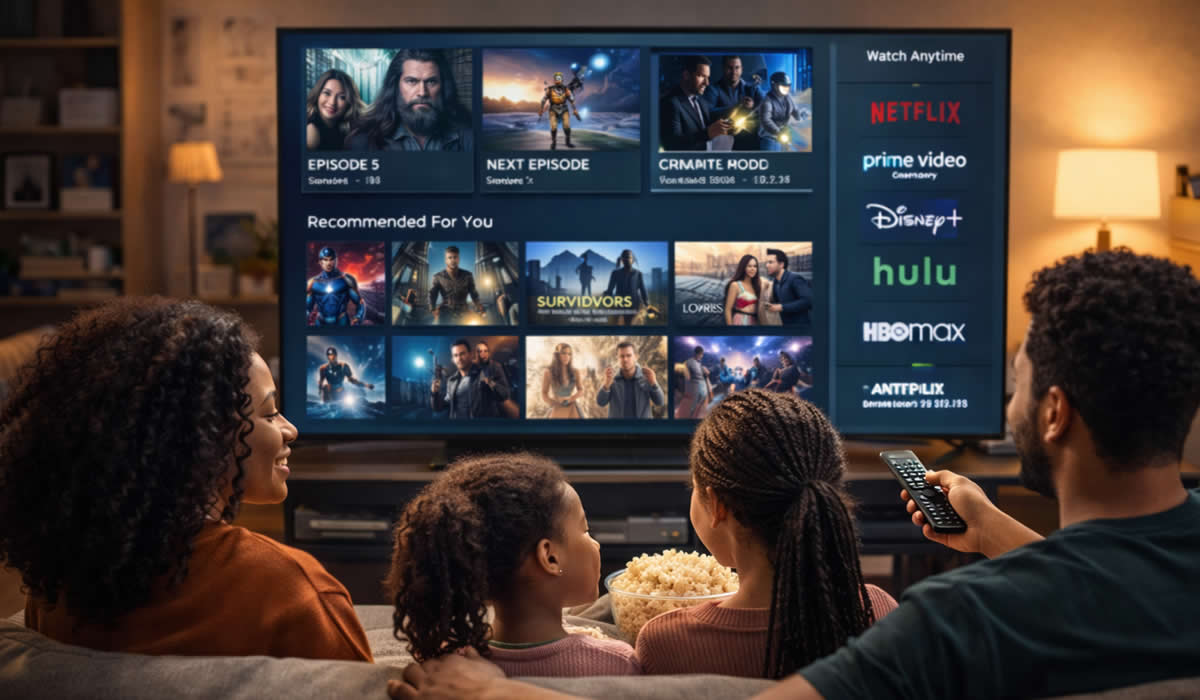
For decades, the rhythm of television was dictated by the hum of the broadcast tower and the rigid ticking of the clock. We lived in an era of “appointment viewing,” where stories were chopped into twenty-two-minute or forty-four-minute segments, punctuated by loud, high-energy commercial breaks designed to keep us from changing the channel. But as we navigate 2026, that era feels like a distant memory. The rise of streaming platforms has not just changed how we watch television; it has fundamentally rewritten the DNA of how stories are told.
The shift from linear broadcasting to on-demand streaming has liberated creators from the “grid.” When a story no longer has to fit between a nightly news slot and a late-night talk show, the narrative possibilities expand. We are witnessing a transformation that touches everything from episode length and season structure to the very way characters are allowed to grow and evolve.
The Death of the “Reset Button”
In the traditional era of television, particularly for sitcoms and procedurals, the “reset button” was a narrative necessity. Because networks relied on syndication and viewers tuning in out of order, each episode had to be relatively self-contained. A character could face a life-altering crisis on Tuesday, but by the following week, the status quo was largely restored.
Streaming has effectively killed the reset button. Because platforms like Netflix, Disney+, and Max are built on a foundation of binge-watching and sequential discovery, creators can now assume the audience has seen every prior minute of the story. This has led to the rise of the “novelistic” television season. Instead of twenty-four loosely connected chapters, a modern season of television functions like a ten-hour movie. Plot points planted in the first ten minutes can bloom in the finale, and character arcs can be agonizingly slow and realistic because there is no pressure to deliver a “complete” story every week.
The Elasticity of Time
One of the most profound changes in 2026 is the total abandonment of standardized runtimes. In the world of cable, an “hour-long” drama was actually about forty-two minutes of content. On a streaming platform, an episode is exactly as long as it needs to be.
We now see “prestige” series where the season premiere might run for seventy-five minutes, while a quiet, character-focused mid-season episode might only last thirty. This elasticity allows for a better emotional pace. Writers are no longer forced to “pad” a thin script to hit a twenty-two-minute mark or, conversely, slash a vital emotional scene because the local news starts at 11:00 PM. This freedom has made TV storytelling feel more organic and less manufactured, mirroring the ebb and flow of a good book rather than a factory assembly line.
Binge-Watching and the “Middle Slump”
While streaming has offered immense creative freedom, it has also introduced new challenges. The “binge model” has changed how writers handle tension. In the weekly release era, the “cliffhanger” was a tool to ensure the audience returned seven days later. In the binge era, the cliffhanger serves as a “just one more” dopamine trigger that leads to the next episode playing automatically.
However, this has led to a phenomenon often called the “Netflix Middle.” Because seasons are released all at once, writers sometimes struggle with the middle episodes of a season, knowing that the audience is likely to power through them in a single sitting. This has led to a shift in focus toward “vibe-based” storytelling, where the atmosphere and world-building become just as important as the individual plot beats of a specific episode. In 2026, we see more “bottle episodes” and experimental formats such as a single episode taking place entirely in a dream sequence or a different time period, because the platform structure allows for these artistic detours without losing the casual viewer.
Personalization and Interactive Narratives
As we look at the technological landscape of 2026, the intersection of AI and storytelling is becoming a tangible reality. Streaming platforms are no longer just repositories for video; they are becoming interactive ecosystems. We are seeing the second generation of “choose-your-own-adventure” style narratives, far more sophisticated than the early experiments of a few years ago.
With the integration of AI-driven personalization, some platforms are experimenting with “generative” sub-plots. While the main arc of a show remains the same for everyone, certain details, such as the background music, the brand of a character’s car, or even minor dialogue references, can be tailored to the viewer’s preferences and location. This creates a hyper-localized experience, where a viewer in Nairobi and a viewer in New York might feel the same emotional weight but see different cultural touchstones reflected on screen.
Global Stories for a Global Audience
Perhaps the most beautiful change brought about by streaming is the total breakdown of geographic borders. In the old world, a non-English language show had a very narrow path to global success, usually relegated to “international” film festivals or niche cable channels. Today, a show produced in Seoul, Lagos, or Madrid can be the number-one trending topic in London and Los Angeles within twenty-four hours.
This has changed the “voice” of TV storytelling. Writers are no longer catering solely to a domestic Western audience. They are leaning into their local cultures, languages, and specific histories, finding that the more authentic and “hyperlocal” a story is, the more universally it resonates. The success of international hits has taught the industry that audiences are willing to read subtitles if the story is compelling enough. This has effectively ended the “Hollywood-only” monopoly on high-budget prestige drama.
The Economic Shift: Quality Over Quantity?
The shift hasn’t been without its growing pains. The “streaming wars” have led to a massive influx of content, sometimes resulting in “choice paralysis” for the consumer. In response, 2026 has seen a move toward “event television” fewer shows, but with much higher production values.
The line between “TV” and “Film” has officially blurred. Many of the most anticipated releases of the year aren’t in theaters; they are ten-episode limited series with budgets that would make a 1990s blockbuster director blush. This “cinematic TV” trend has attracted top-tier talent from the film world directors, cinematographers, and A-list stars who are drawn to the medium because it offers more time to explore a character’s interior life than a two-hour movie ever could.
Summary of Storytelling Shifts
| Feature | Traditional TV (Cable/Broadcast) | Streaming TV (2026 Era) |
| Narrative Form | Episodic/Self-contained | Serialized/Novelistic |
| Episode Length | Fixed (22 or 44 minutes) | Fluid (Variable based on story) |
| Consumer Access | Appointment Viewing | On-Demand/Binge |
| Pacing | Fast/Commercial-friendly | Atmospheric/Slow-burn |
| Geographic Scope | Domestic-focused | Global/Hyperlocal |
| Audience Input | Passive Viewing | Interactive/Personalized |
As we look at the landscape of television today, it is easy to get caught up in the talk of algorithms and data-driven recommendations. But at its heart, the change brought by streaming platforms is a human one. We have moved back toward the ancient roots of storytelling, long-form, immersive tales that don’t need to be interrupted by a loud advertisement for laundry detergent.
Streaming has given us the chance to sit with characters for years, to see them fail and grow in real-time, and to explore worlds that were previously too expensive or too “niche” for the local airwaves. While the technology will continue to evolve, the true legacy of the streaming era will be the democratization of the story. In 2026, the best show in the world could come from anywhere, be watched at any time, and last for as long as it takes to tell the truth.
About The Author